Why Turning a Hobby Into a Job Can Kill Your Passion
Jun 3, 2025 • 6 min read
When we were kids, a lot of us had this dream like, “How cool would it be if i could turn my hobby into a job?” If you loved drawing, you probably wanted to be a comic artist. If you were into gaming, you dreamed of becoming a pro player. If you enjoyed cooking, maybe you imagined opening a cute little cafe.
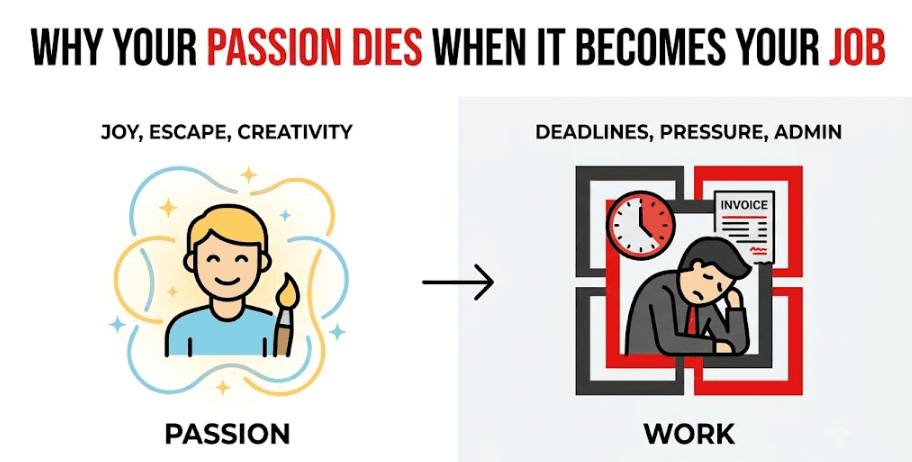
Introduction
When we were kids, a lot of us had this dream like, “How cool would it be if i could turn my hobby into a job?” If you loved drawing, you probably wanted to be a comic artist. If you were into gaming, you dreamed of becoming a pro player. If you enjoyed cooking, maybe you imagined opening a cute little cafe.
It all sounded like the perfect life, doing what you love and getting paid for it.
But the reality? it’s not always that sweet. Many people end up feeling burned out, drained, and even lose their spark when their hobby becomes their job.
Why does that happen?
Let’s talk about it, why turning a hobby into a career sometimes slowly kills your passion. Don’t worry, it’s not all doom and gloom, but it’s worth understanding the risks.
What’s the Difference Between a Hobby, Passion, and a Job?
Before we go deeper, let’s clear something up. People often mix up hobby, passion, and job but they’re not the same thing.
Hobby
A hobby is something you do just because you enjoy it. No pressure, no goals just pure fun.
Examples: taking photos of flowers, playing guitar in your room, doodling, or trying out random TikTok recipes.
Passion
Passion is deeper than a hobby. It’s something you’re not just into you feel a strong drive to learn, grow, and improve. You’re willing to push yourself because you truly care.
Example: staying up late learning how to code because you want to build your own app, or constantly exploring photography techniques because you dream of having your own exhibition.
Job
A job is something you do for money or responsibility. It might align with your passion, or it might not. But one thing’s for sure there are expectations, targets, and pressure.
Why Turning a Hobby Into a Job Can Lead to Burnout
People love the idea of “getting paid to do what you love.” But not every hobby is meant to become a job. Here’s why it can backfire:
1. Money Pressure Makes It Feel Too Serious
Once your hobby becomes a money-making activity, everything changes. Suddenly, you have goals like:
“I need X number of clients this month.”
“This post needs more views.”
“The design has to match the client’s taste.”
Now you’re thinking about sales, branding, deadlines, feedback. The fun part fades. You’re no longer drawing because you want to — you’re drawing because you have to.
And that pressure? It builds fast.
2. Repetition and Deadlines Wear You Out
When your hobby becomes a job, you have to do it constantly. Every day. Even when you’re not feeling it. For example:
You used to bake when you were in the mood.
Now? You bake every single day even when you’re exhausted.
Repetition makes something fun feel boring and draining over time.
3. Creativity Gets Boxed In
When your hobby was just for fun, you had total freedom. You could create whatever you wanted, however you wanted. But as a job? You have to follow:
Client briefs
Market trends
Endless revisions
Soon, you’re creating what sells, not what you love. That creative freedom disappears and with it, your motivation.
4. Expectations Keep Getting Higher
As people start recognizing your work, expectations pile on. Friends, clients, followers they all expect you to be:
Amazing
Consistent
Professional
But we’re human. We get tired. We hit creative blocks. Feeling like you have to “always be great” can weigh you down mentally and emotionally.
5. You Lose Your “Play” Time
Hobbies give us an escape from stress. But if your hobby becomes your job, where do you go when you need a break?
You used to love editing videos it was your happy place.
Now? Just seeing the editing app icon gives you anxiety.
Without that playful outlet, your stress builds up with nowhere to go.
My Personal Experience
Back in middle school, I fell in love with video editing. There was this deep satisfaction in putting together clips and turning them into one complete story. Even though my laptop was slow and my software limited, I kept learning because I genuinely enjoyed it. I’d stay up late watching tutorials, playing with transitions and audio not because I had to, but because I wanted to.
In high school, editing became my escape. When school got intense and I was exhausted, I’d go straight to my editing software. It wasn’t a chore it was therapy. I started diving deeper into things like color grading, editing styles, and transitions, purely out of curiosity.
But then came college. Things started to shift. People found out I was good at editing and began asking me for help. At first, I was happy my work was appreciated, and I even earned a little money. But slowly, the fun faded. I couldn’t just edit the way I liked anymore I had to follow others’ requests. “Can you make it like this?” “Change the tone.” “Make the cut smoother.”
I didn’t feel like an artist anymore. I felt like an “editing machine.” I wasn’t creating out of joy I was producing because I had to. And that burned me out. Eventually, I started turning down gigs. Not because I hated editing, but because I didn’t want to lose what little passion I had left.
That’s when I realized something:
It wasn’t me that changed.
It was how I approached the hobby.
I let others’ expectations take over, and I forgot why I started editing in the first place.
How to Keep Your Passion Alive (Even If It Becomes Your Job)
I’m not saying you should never turn your hobby into a career. But if you do, here are some tips to keep the fire burning:
Set Aside Time Just for Fun
Don’t monetize everything. Leave some space to enjoy your hobby purely for pleasure no deadlines, no clients, no pressure.Know Your Limits
You don’t have to say yes to every request. Protect your energy and only take on projects that align with your creative vision.Separate “Work Mode” from “Play Mode”
Create a space just for personal expression like a second account or portfolio that’s 100% you.Remember Why You Started
When things get heavy, pause and reflect. Why did you fall in love with this in the first place?Take Breaks Without Guilt
Passion fatigue is real. Taking time off doesn’t make you weak it helps you recharge and reconnect with what matters.
Final Thoughts
Turning your hobby into a job can be amazing but it can also backfire if you’re not careful. The key is balance. Don’t let the pressure kill your joy. Keep a little corner of your hobby just for you free, playful, and pressure-free.
Because in the end, your hobby should be your safe space.
Not another source of stress.
Related posts

A Graduate
Kalau ada satu hal yang gue pelajari selama 3,8 tahun di Universitas Mulawarman, itu adalah bahwa waktu selalu berhasil mengubah seseorang.
Apr 22, 2026 • 3 min read
Lessons Learned from a Year as an Information Systems Laboratory Assistant
Kalau ada yang nanya ke gue, "Apa salah satu keputusan paling berharga yang pernah lo ambil selama kuliah?"
Nov 6, 2025 • 3 min read
I Thought It’d Be Hard, But It Wasn’t! My Bangkit 2024 Journey
Hey folks! I’m Fauzan, a proud graduate of Bangkit Academy 2024 Batch 2. Today, I want to share my journey of completing the Bangkit program something that many people think is super tough.
Jan 23, 2025 • 8 min read